Planning Permission for a Wood-Fired Sauna in the UK
You want a wood-fired sauna in your garden. The stove is picked, the builder is shortlisted, the spot in the garden is cleared. Then someone mentions planning permission and the whole thing stalls.
The good news: most domestic garden saunas in the UK do not need a formal planning application. They fall under permitted development — a set of rules that allows certain outbuildings without going through the full planning process. But permitted development is not a blanket exemption. It comes with conditions on height, size, placement, and what you do inside the building. Get one wrong and you need planning permission after all — or risk enforcement action.
This guide covers the full regulatory picture for installing a wood-fired sauna in the UK: permitted development rules for England, Wales, Scotland, and Northern Ireland; building regulations for the shell and the services inside it; wood-burning stove and flue requirements; smoke control areas; protected designations; commercial use; and the practical process if you do need to apply. It is written for homeowners and small operators, not for lawyers — but the rules referenced are real and current as of early 2026.
Important: planning rules and building regulations are separate systems. You may need to satisfy one, both, or neither. This guide covers both.
Do you need planning permission?
The short answer for most people: probably not, if your sauna is a detached outbuilding in the rear garden of a house, you stay within the size and height limits, and your property is not in a protected area or subject to special restrictions.
The longer answer depends on five things:
- What nation you are in — England, Wales, Scotland, and Northern Ireland each have their own permitted development order with different thresholds
- Where on the plot the sauna goes — front gardens are almost always excluded; proximity to boundaries triggers lower height limits
- How big it is — total outbuilding coverage, height, and footprint all matter
- Whether the property has protected status — listed buildings, conservation areas, AONBs, National Parks, and Article 4 directions can remove or restrict PD rights
- What you put inside it — a wood-burning stove, electrical supply, shower, or toilet each trigger separate regulatory requirements even when the shell itself is exempt
The following sections work through each of these in detail.
Permitted development rules by nation
Permitted development (PD) allows certain types of building work without a formal planning application. For outbuildings — including garden saunas — the relevant rules sit under Class E (England), the equivalent Welsh provisions, Class 3C (Scotland), and Class D Part 1 (Northern Ireland). Each nation sets its own limits.
In all four nations, the sauna must be genuinely ancillary to the house — used for a purpose incidental to the enjoyment of the dwelling. A personal sauna qualifies. A commercial sauna operating from a residential garden may not (see the commercial use section below).
England
Under the Town and Country Planning (General Permitted Development) (England) Order 2015, Schedule 2, Part 1, Class E:
- Single storey only
- Not forward of the principal elevation facing a highway
- Maximum eaves height: 2.5 metres
- Maximum overall height: 4 metres (dual-pitched roof) or 3 metres (any other roof type, including flat, mono-pitch, and barrel)
- Within 2 metres of any boundary: maximum overall height drops to 2.5 metres
- Total area of all outbuildings, extensions, and other buildings within the curtilage must not exceed 50% of the total curtilage area (excluding the original house footprint)
- No verandas, balconies, or raised platforms above 0.3 metres (300mm)
- No satellite antenna on the building
The 0.3-metre platform limit is the one that catches people. A standard timber deck at 450mm above ground level — common with barrel saunas and pod saunas — exceeds this threshold and takes the whole project outside permitted development. Solutions: lower the deck, recess it into the ground, or apply for planning permission for the platform.
Wales
Wales follows substantially the same rules as England under the Town and Country Planning (General Permitted Development) Order 1995 (as amended for Wales), with one additional restriction:
- Any part of the outbuilding within 2 metres of the house itself must not exceed 1.5 metres in height
This is separate from the boundary rule. In a small garden where the sauna sits close to both the house and a boundary, both the 2.5m boundary limit and the 1.5m house-proximity limit apply simultaneously — the lower figure governs.
Scotland
Under the Town and Country Planning (General Permitted Development) (Scotland) Order 1992 (as amended), Class 3C:
- Must be to the rear of the house (behind the rear wall of the original dwelling)
- Maximum eaves height: 3 metres (higher than England and Wales)
- Maximum overall height: 4 metres
- Within 1 metre of any boundary: maximum height drops to 2.5 metres (note: 1m threshold, not 2m as in England)
- Total outbuildings must not cover more than 50% of the rear curtilage
- Raised platforms up to 0.5 metres above ground level are permitted (more generous than England's 0.3m)
Scotland's rules are slightly more generous on eaves height and platform height but stricter on the boundary setback distance (1m vs 2m in England). Check both the height and the boundary distance — they interact.
Northern Ireland
Under the Planning (General Permitted Development) Order (Northern Ireland) 2015, Part 1, Class D:
- Maximum overall height: 4 metres
- Within 2 metres of a boundary: maximum height 2.5 metres (matching England)
- Must be at least 3.5 metres from any road boundary at the rear
- Total area of all outbuildings must not exceed 50% of the curtilage
- Total outbuilding floor area capped at 25m² (this is unique to Northern Ireland and rules out larger sauna buildings)
- Decks, balconies, verandas, and raised platforms are excluded from Class D permitted development entirely — any raised platform of any height requires a planning application
Northern Ireland is the most restrictive of the four nations. The 25m² total outbuilding cap and the complete exclusion of raised platforms are the two rules that most commonly trip people up.
Nation-by-nation comparison
| Rule | England | Wales | Scotland | N. Ireland |
|---|---|---|---|---|
| Max eaves height | 2.5m | 2.5m | 3m | 2.5m |
| Max overall height | 4m (dual pitch) / 3m (other) | 4m (dual pitch) / 3m (other) | 4m | 4m |
| Boundary setback for height reduction | 2m → max 2.5m | 2m → max 2.5m | 1m → max 2.5m | 2m → max 2.5m |
| Max site coverage | 50% of curtilage | 50% of curtilage | 50% of rear curtilage | 50% of curtilage + 25m² cap |
| Raised platform limit | 0.3m (300mm) | 0.3m (300mm) | 0.5m (500mm) | Not permitted under PD |
| Protected area footprint limit | 10m² if >20m from house | 10m² if >20m from house | 4m² in conservation areas | 10m² if >20m from house |
All four nations require the building to be single storey, genuinely ancillary to the house, and not forward of the principal elevation. Flats, maisonettes, and buildings converted under PD (such as barn conversions) generally have reduced or no PD rights.
The decking trap
Raised platforms are the single most common reason a domestic sauna project accidentally falls outside permitted development. The issue is not the sauna itself but the deck, veranda, or platform it sits on.
Why it matters
Many sauna types — barrel saunas, pod saunas, some cabin designs — are sold with or installed on a timber deck. If any part of the deck surface sits more than 0.3 metres (300mm) above the existing ground level in England or Wales, or 0.5 metres in Scotland, the entire structure loses its permitted development status. In Northern Ireland, raised platforms of any height are excluded from Class D entirely.
This catches people because:
- A standard timber deck on joists is typically 400–500mm above ground — already over the England/Wales limit
- Sloping sites push one end of the deck higher, and height is measured at the highest point
- The platform rule applies to the finished surface, not just the structure underneath
Solutions
- Lower the deck: Use a ground-level system — adjustable pedestals, sunken joists, or composite deck tiles laid directly on a prepared base
- Recess into the ground: Excavate the area so the finished deck surface sits within the height limit relative to the original ground level
- Separate the deck from the sauna: The platform limit applies to structures associated with the outbuilding. A freestanding patio area at ground level adjacent to (but not attached to) the sauna avoids the issue entirely
- Apply for planning permission for the deck: If the deck design matters to you, submit a householder application for the platform. The sauna itself may still qualify as PD
This is worth checking early. If your builder supplies the sauna on a raised frame or integral deck, ask them to confirm the finished platform height relative to existing ground level before ordering.
Protected areas and listed buildings
Permitted development rights are reduced or removed entirely for properties in designated areas. If your home falls within any of the following, do not assume PD applies — check with your local planning authority before proceeding.
Areas of Outstanding Natural Beauty (AONBs) / National Landscapes, National Parks, the Broads, and World Heritage Sites
In England, Wales, and Northern Ireland, outbuildings located more than 20 metres from any wall of the house are limited to a 10m² maximum footprint. Closer than 20 metres, the normal PD size limits apply — but the 10m² cap at distance effectively prevents a larger sauna building at the bottom of the garden in these areas.
Conservation areas
In England and Wales, the same 10m² distance rule applies in conservation areas. In Scotland, permitted development in conservation areas is restricted to a 4m² footprint — effectively ruling out most saunas without a planning application.
Listed buildings
This is the strictest category. Any building within the curtilage of a listed building generally requires both full planning permission and listed building consent for new outbuildings — regardless of size. There is no PD exemption for outbuildings in the curtilage of a listed building.
Unauthorised works affecting a listed building or its setting can be a criminal offence under the Planning (Listed Buildings and Conservation Areas) Act 1990 (England and Wales) or equivalent legislation in Scotland and Northern Ireland. This is not just an enforcement notice — it carries the possibility of prosecution and fines.
Article 4 directions
Local authorities can issue Article 4 directions that remove specific permitted development rights in defined areas. These are not always obvious — they do not always correspond to conservation areas or other designations. Check your local authority's interactive planning map or call their planning department to confirm whether any Article 4 directions apply to your property.
How to check
Your local authority's planning department can confirm your property's status. Most councils publish interactive constraint maps online showing conservation areas, listed buildings, AONBs, and Article 4 directions. If you are in any doubt, a quick phone call to the planning duty officer costs nothing and could save you from an enforcement notice.
Building regulations
Planning permission and building regulations are separate systems. A sauna can qualify as permitted development but still need building control sign-off — or need planning permission but be exempt from building regulations. You may need to satisfy one, both, or neither. Treat them as two independent checklists.
Size exemptions for the shell
In England and Wales, detached single-storey outbuildings are assessed by internal floor area:
- Under 15m²: Generally exempt from building regulations for the shell structure, provided there is no sleeping accommodation
- 15–30m²: Exempt only if situated at least 1 metre from any boundary, or constructed substantially of non-combustible materials
- Over 30m²: Full building regulations approval required for the structure
In Northern Ireland, the thresholds are similar but the under-15m² exemption additionally requires the building to be at least 1 metre from the main dwelling.
Scotland: building warrant
Scotland uses a building warrant system rather than the English building regulations framework. A detached building between 8m² and 30m² ancillary to a house does not normally require a building warrant — but this exemption specifically excludes buildings containing a fixed combustion appliance or a sanitary facility (shower, WC, basin). Since most wood-fired saunas contain a stove, and many include a shower or cold plunge drain, most wood-fired saunas in Scotland will require a building warrant regardless of size.
This is the single biggest difference between Scotland and the other three nations for sauna projects. Budget for it early.
Services that are always regulated
Even when the shell is exempt from building regulations, the services installed inside it are not. Each of the following triggers its own regulatory requirement:
- Approved Document P (electrical safety): Any outbuilding receiving an electrical supply from the dwelling falls under Part P. Sauna rooms and sauna heater circuits are classified as special locations — all electrical work is notifiable and must be carried out or certified by a Part P registered electrician. This applies whether the sauna is electric or wood-fired (most wood-fired saunas still need lighting, and some have electric backup heaters)
- Approved Document J (combustion appliances and fuel storage): Applies to the wood-burning stove, flue, and chimney installation. Covered in detail in the next section
- Approved Document H (drainage and waste disposal): Applies if you plumb in a shower, cold plunge with a drain, or any water discharge. A simple bucket-and-ladle sauna with no plumbed drainage does not trigger Part H
- Approved Document B (fire safety): Relevant for fire spread to boundaries, particularly with combustible timber-clad construction close to a neighbour's property
- Approved Document L (conservation of fuel and power): May apply to heated outbuildings depending on the heating system and intended use pattern — though enforcement on small ancillary outbuildings is unusual
The shower and WC trap
Adding a toilet, shower, or guest bed is the single most common reason a small outbuilding loses its building regulations exemption. A plumbed shower triggers Part H (drainage) and Part P (electrics for the pump or heated water supply). A WC triggers foul drainage requirements. A bed triggers sleeping accommodation rules that remove the under-15m² exemption entirely.
More subtly, a sauna building with a shower, WC, and kitchenette can start to look like a separate dwelling — which may trigger council tax liability for a second residential unit. If you want plumbing, factor building control into the project from the start and keep the internal layout clearly ancillary to the main house.

Wood-burning stoves, flues, and smoke control
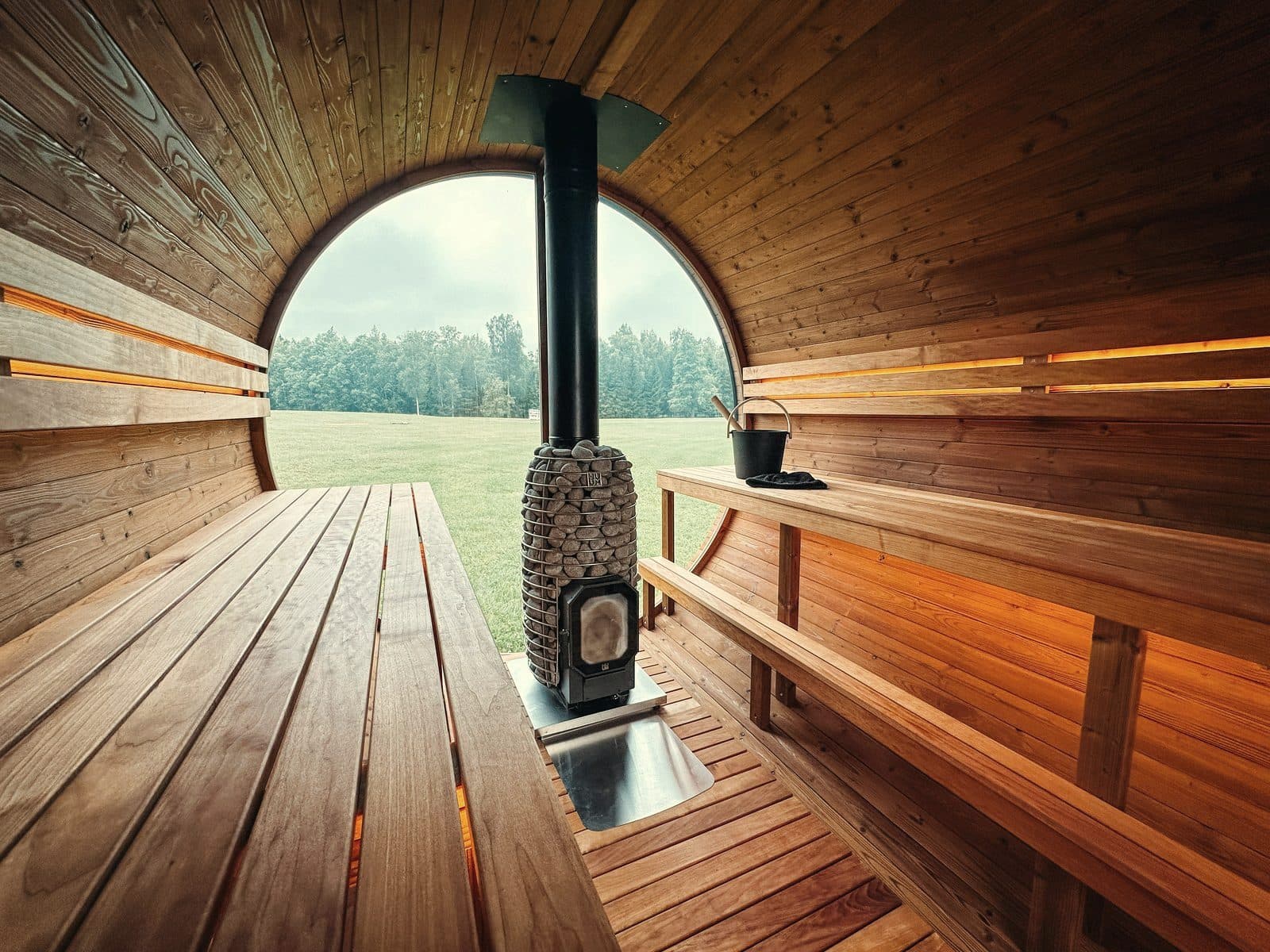
The stove and flue installation is the most regulated part of a wood-fired sauna. It sits at the intersection of building regulations (Approved Document J), clean air legislation, and manufacturer installation requirements. A badly installed flue is a fire risk and a carbon monoxide risk.
Approved Document J (England and Wales)
Document J covers the installation of combustion appliances, flue pipes, and chimneys. For a wood-burning sauna stove, the key requirements include:
- Minimum clearance distances between the stove and combustible materials (walls, benches, ceiling) — typically 200–500mm depending on the stove and any heat shielding
- A non-combustible hearth of adequate thickness and extent beneath the stove
- Flue must be the correct diameter for the stove output (typically specified by the stove manufacturer)
- Flue must terminate at least 600mm above the ridge of the building, or at least 2.3 metres above the top of any openable window, skylight, or air vent within 2.3 metres horizontally
- Adequate combustion air supply — wood-burning stoves need a direct external air supply, and a sealed sauna room makes this critical
- Carbon monoxide alarm required in the room where the appliance is installed
A HETAS-registered installer can both fit the stove and self-certify compliance with Document J, notifying building control on your behalf. Using a non-HETAS installer means you need to arrange a separate building control inspection — which adds cost and complexity.
Scotland
Scotland follows the Scottish Building Standards (Technical Handbook, Section 3: Environment) rather than Approved Document J. The principles are similar — safe clearances, adequate flue height, combustion air — but the specific standards and certification routes differ. A HETAS-registered installer operating in Scotland will be familiar with both frameworks.
Smoke control areas
Under the Clean Air Act 1993 (England and Wales) and equivalent legislation in Scotland and Northern Ireland, it is an offence to emit smoke from a chimney in a designated smoke control area unless you are burning an authorised fuel or using a DEFRA-exempt appliance.
Many urban and suburban areas of the UK are smoke control zones. If your property is in one, you have two options:
- Use a DEFRA-exempt stove: These stoves are tested and approved for use in smoke control areas. The full list of exempt appliances is published on GOV.UK. Not all sauna stoves are on the list — check before buying
- Burn authorised smokeless fuel only: Standard kiln-dried logs are not classified as an authorised smokeless fuel. In practice, this means you need a DEFRA-exempt stove if you want to burn wood in a smoke control area
Penalties for breaching smoke control rules were increased significantly by the Environment Act 2021. Fines can reach several thousand pounds per offence. Check your council's smoke control map before committing to a wood-fired sauna — if you are in a smoke control area and cannot source a suitable DEFRA-exempt sauna stove, an electric sauna heater may be the more practical option.
Flue height and neighbours
Even outside smoke control areas, smoke and smell from a sauna flue can cause neighbour disputes. Flue height matters: a short flue on a low outbuilding discharges smoke at head height, which drifts into neighbouring gardens. A taller flue improves dispersal. Document J sets minimum heights for safety, but consider going higher for neighbourliness — particularly in terraced or semi-detached gardens.
Commercial use and mobile saunas
The rules above apply to domestic use — a sauna ancillary to a private dwelling. If you plan to operate commercially, the regulatory picture changes.
Change of use
Running a sauna business from a residential property may constitute a material change of use under planning law. Whether it does depends on the scale and character of the activity — occasional private hire may not trigger a change of use, but regular bookings with public advertising, car parking, and foot traffic almost certainly will.
A material change of use requires planning permission. The relevant use class is typically E(d) (indoor sport, recreation, or fitness) or sui generis depending on how the operation is structured. Your local planning authority can advise on whether your proposed operation constitutes a change of use.
Licensing and safety
Commercial sauna operations face additional requirements beyond planning:
- Health and safety: The Health and Safety at Work Act 1974 applies. You need a risk assessment covering burns, slips, carbon monoxide, electrical safety, and water hygiene (Legionella)
- Public liability insurance: Essential for any business welcoming the public
- Fire safety: The Regulatory Reform (Fire Safety) Order 2005 (England and Wales) requires a fire risk assessment for commercial premises. Scotland and Northern Ireland have equivalent legislation
- Accessibility: The Equality Act 2010 requires reasonable adjustments for disabled access
- Water hygiene: If you have a hot tub, plunge pool, or shower, HSE guidance on Legionella risk management (HSG274/L8) applies
Mobile saunas
Trailer-mounted and towable saunas occupy a grey area. A mobile sauna that is genuinely moved between sites and does not remain in one location permanently is less likely to require planning permission — but there is no blanket exemption. Key considerations:
- Duration and permanence: A sauna trailer parked in the same spot for months at a time may be treated as a permanent structure by the planning authority, regardless of whether it has wheels
- Operating from private land: If you operate a mobile sauna business from a fixed residential base (stored at home, bookings managed from home), the base of operations may still constitute a change of use
- Operating on third-party land: Events, festivals, and pop-ups on other people's land typically fall under the landowner's permissions. Check whether the site has suitable event or temporary use permissions
- Road legality: If the trailer is towed on public roads, it must be roadworthy, correctly hitched, and within your vehicle's towing capacity. Lighting boards, number plates, and braking requirements apply
If you are starting a mobile sauna business, get planning advice specific to your base of operations early. Our guide on starting a sauna business (coming soon) will cover the wider commercial setup in more detail.
The planning process: what to do and what it costs
If you need planning permission — or want formal confirmation that you don't — here are the main routes.
Lawful Development Certificate (LDC)
If you believe your sauna qualifies as permitted development, you can apply for a Lawful Development Certificate. This is not planning permission — it is a formal legal confirmation from the council that your project is lawful under PD. It is optional but useful, particularly if you plan to sell the property later or want certainty before spending money on the build.
- England: £120 (proposed development, check current fees with your council — fees are periodically updated)
- Scotland: £120
- Wales: £120
- Northern Ireland: varies — check your council
- Typical decision time: 8 weeks
Pre-application enquiry
Most councils offer a pre-application advice service — an informal discussion with a planning officer about whether your proposal is likely to get permission. Fees vary widely (some councils offer free advice for householder proposals, others charge £50–£300). This is particularly useful if your property is in a protected area or near a boundary condition.
Full householder planning application
If PD does not apply and you need formal planning permission:
- England: £258 for a householder application (check current fees with your council)
- Scotland: £300
- Wales: £230
- Northern Ireland: £220
- Typical decision time: 8 weeks (though delays are common)
You will need to submit drawings (site plan and elevations), a design and access statement (in most cases), and possibly supporting documents depending on your property's constraints. Many builders can supply the required drawings, or a local architectural technician can prepare them for £200–£500.
Listed building consent
If your property is a listed building, you need listed building consent in addition to planning permission. There is no fee for a listed building consent application, but the process typically takes longer and requires a heritage impact assessment. Expect 8–13 weeks and potentially a site visit from a conservation officer.
Building control
Separate from planning. If your sauna needs building regulations approval (for the structure, electrics, stove, or drainage), you can use either:
- Local authority building control (LABC): Submit a building notice or full plans application. Fees vary by council and project scope — typically £200–£500 for a small outbuilding
- Approved inspector: A private-sector alternative. Often faster but may cost more
- Self-certification: A HETAS installer can self-certify the stove and flue. A Part P electrician can self-certify the electrics. Each will notify building control directly. This is usually the simplest route for a standard sauna installation
What happens if you get it wrong
Building a sauna without the necessary permissions is not automatically a criminal offence (unless a listed building is involved). But it can lead to enforcement action, which is stressful, expensive, and sometimes requires demolition.
Enforcement notices
If a local authority becomes aware of unauthorised development — usually through a neighbour complaint — they can investigate and issue an enforcement notice requiring you to remedy the breach. This might mean removing the structure, reducing its height, or submitting a retrospective planning application.
Retrospective planning permission
You can apply for planning permission after the fact. There is no penalty for applying retrospectively — the application is assessed on its merits, the same as if you had applied in advance. But there is no guarantee of approval, and if permission is refused, you may be required to remove the structure.
Time limits
In England and Wales, the general rule is:
- 4 years for building operations (the physical structure) — if an unauthorised building has stood for 4 years without enforcement action, it becomes immune from enforcement
- 10 years for change of use — if an unauthorised use has continued for 10 years, it becomes immune
In Scotland, the equivalent period is 4 years for all breaches. Northern Ireland uses similar timeframes but the details differ — check with your local council.
These time limits do not apply to listed buildings — there is no time limit for enforcement action against unauthorised works to a listed building.
The practical risk
In reality, enforcement action against a small domestic sauna in a rear garden is relatively uncommon — most local authorities prioritise larger breaches. But it does happen, particularly when:
- A neighbour complains (the most common trigger)
- The sauna is being used commercially without permission
- The property is in a conservation area or is a listed building
- The structure is visually prominent or significantly oversized
The cheapest insurance is doing the homework upfront. An LDC costs £120. Removing a sauna costs considerably more.
Common mistakes
Based on planning forums, builder feedback, and enforcement records, these are the errors that come up most often:
- Assuming PD applies without checking: PD is conditional, not automatic. Properties in protected areas, flats, converted buildings, and those with Article 4 directions may have no PD rights at all
- Confusing planning permission with building regulations: They are separate systems. A building can be PD but still need building control sign-off for the stove, electrics, or drainage
- Ignoring the platform height limit: A timber deck at 450mm pushes the entire project outside PD in England and Wales. Measure from existing ground level, not from the base of the deck frame
- Forgetting the 50% curtilage rule: The total area of all outbuildings, extensions, and structures (not just the sauna) must stay under 50% of the curtilage. If you already have a garage, shed, and extension, the remaining allowance may be smaller than you think
- Not checking smoke control status: Installing a non-exempt stove in a smoke control area is an offence. Check before you buy the stove, not after
- Skipping HETAS certification: A stove installed without HETAS sign-off (and without separate building control inspection) has no compliance certificate. This causes problems when you sell the property — conveyancing solicitors will flag it
- Adding plumbing without building control: A shower or cold plunge drain triggers Part H. A toilet removes the under-15m² exemption entirely
- Not telling neighbours: Even when no permission is needed, smoke, noise, and visual impact can cause disputes. A conversation before the build starts costs nothing and prevents most complaints
When to get professional help
Most straightforward domestic sauna installations — a standard-sized cabin or barrel sauna in the rear garden of an unrestricted property — can be navigated without professional planning advice. Read the rules, check your property status, use a HETAS installer for the stove, and use a Part P electrician for the wiring.
Consider professional help if:
- Your property is a listed building or in a conservation area
- You are in an AONB, National Park, or World Heritage Site
- You want to operate commercially from the property
- Your garden is unusually constrained (small, sloping, multiple boundaries close by)
- You have already received an enforcement notice or pre-enforcement enquiry
- You want to combine the sauna with other works (extension, annexe, landscaping) that may interact with PD limits
A planning consultant typically charges £300–£800 for a householder feasibility assessment and application preparation. For listed buildings, a heritage consultant is advisable — expect £500–£1,500 depending on the complexity of the heritage impact assessment.
For the stove and flue: always use a HETAS-registered installer. For electrics: always use a Part P registered electrician. These are not areas where DIY or unregistered tradespeople should be doing the work — both for safety and for the compliance certificates you will need when selling the property.
Quick-reference checklist
Before you commit to a build, work through this list:
- Check your property status: Listed building? Conservation area? AONB? Article 4 direction? Check your council's interactive planning map
- Measure your curtilage coverage: Add up all existing outbuildings and extensions. Will the sauna push you over 50%?
- Check heights and distances: Overall height, eaves height, distance to boundaries. Use the comparison table above for your nation
- Check the platform: Will the sauna sit on a raised deck? Measure finished height above existing ground level
- Check smoke control: Is your property in a smoke control area? If yes, is your chosen stove DEFRA-exempt?
- Plan the stove installation: Book a HETAS-registered installer. They will handle Document J compliance and building control notification
- Plan the electrics: Book a Part P registered electrician for the supply, lighting, and any heater circuit
- Plan drainage: Will you have a shower, plunge pool, or any water discharge? If yes, arrange building control for Part H
- Talk to your neighbours: Even when you don't need permission, a conversation about what you are building, where the flue will be, and how you plan to manage smoke goes a long way
- Consider an LDC: If you want formal confirmation that your project qualifies as PD, apply for a Lawful Development Certificate (£120, 8 weeks)
Next steps
If you are still in the planning stage, our outdoor sauna planning checklist covers foundations, drainage, delivery access, and the full pre-build sequence. If you are looking for a builder, the how to choose a sauna builder guide covers what to look for and what to ask.
Planning rules change. The legislation referenced in this guide is current as of early 2026, but fees, thresholds, and local policies are updated periodically. Always confirm current figures with your local authority before making decisions based on specific numbers.
Frequently asked questions
- Most domestic garden saunas in the UK do not need planning permission. They fall under permitted development as outbuildings ancillary to the house, provided they meet height, size, and placement conditions. The exact limits depend on whether you are in England, Wales, Scotland, or Northern Ireland, and whether your property has any protected designation such as a listed building or conservation area.
- In England and Wales, the maximum overall height is 4 metres with a dual-pitched roof or 3 metres for any other roof type. Within 2 metres of a boundary, the maximum drops to 2.5 metres. Scotland allows 3-metre eaves and 4-metre overall height, with a 2.5-metre limit within 1 metre of a boundary. Northern Ireland follows similar limits to England.
- It depends on the size and what is inside it. Detached outbuildings under 15 square metres are generally exempt from building regulations for the shell structure. But the services inside — wood-burning stove, electrical supply, plumbed drainage — are regulated regardless of building size. A HETAS installer handles stove compliance and a Part P electrician handles the electrics.
- Yes, but only if you use a DEFRA-exempt stove — one that has been tested and approved for use in smoke control areas. Standard sauna stoves may not be on the exempt list. Check the DEFRA exempt appliances register on GOV.UK before buying. Using a non-exempt stove in a smoke control area is an offence with fines of several thousand pounds.
- There is no blanket exemption for mobile saunas. A trailer-mounted sauna that is genuinely moved between sites is less likely to need planning permission than one parked permanently in a garden. But a mobile sauna kept in one location for extended periods may be treated as a permanent structure. If you operate commercially, the base of operations may require a change of use application regardless of whether the sauna itself moves.
- A Lawful Development Certificate (LDC) is formal confirmation from your local council that a proposed development is lawful under permitted development rules. It costs around £120 and takes about 8 weeks. It is optional but provides legal certainty, which is particularly useful when selling the property or if you want written proof before starting a build.
- Yes, but with height restrictions. In England and Wales, any part of the building within 2 metres of a boundary must not exceed 2.5 metres in overall height. In Scotland, the threshold is 1 metre from the boundary. There is no minimum setback distance from the boundary itself — the restriction is on height, not placement.
- Yes, and this is the most common mistake. In England and Wales, raised platforms above 0.3 metres (300mm) take the project outside permitted development. A standard timber deck on joists is typically 400-500mm high, which exceeds this limit. In Northern Ireland, raised platforms of any height are excluded from permitted development entirely. Solutions include lowering the deck, recessing it into the ground, or applying for separate planning permission for the platform.
Do I need planning permission for a sauna in my garden?
What is the maximum height for a garden sauna without planning permission?
Do I need building regulations approval for a garden sauna?
Can I have a wood-burning sauna stove in a smoke control area?
Do I need planning permission for a mobile sauna?
What is a Lawful Development Certificate?
Can I build a sauna near my boundary?
Does a raised deck affect planning permission for my sauna?
Related guides
Outdoor Sauna Planning Checklist
Permissions, foundations, drainage, electrics, flues, and everything else to check before installing an outdoor sauna in the UK.
Building & planningHow to Choose the Right Sauna Builder
What to ask, what to look for, and common mistakes to avoid when commissioning a sauna build in the UK.
Getting startedWood-Fired vs Electric Sauna: What’s the Difference?
Practical comparison of wood-fired and electric saunas covering heat, running costs, installation, UK regulations, and which suits different settings.